Eligibility rules for long-term experience, high annual turnover, and prior execution of large contracts non-mandatory.
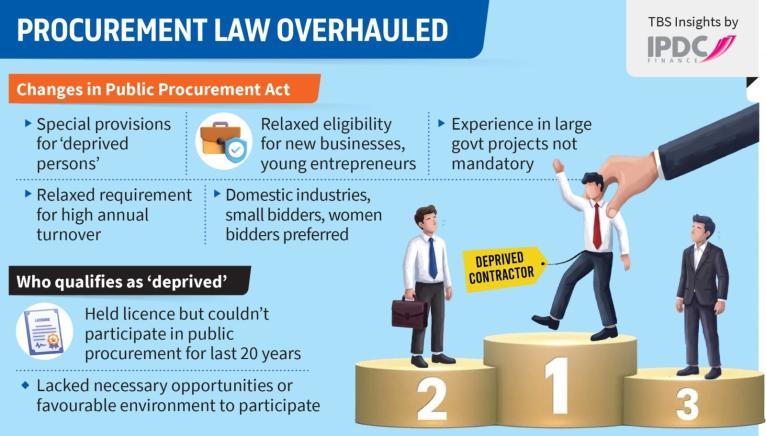
The government has amended the Public Procurement Act, introducing provisions that grant preferential treatment to contractors classified as “deprived persons” and relax eligibility criteria for state tenders. The Public Procurement (Second Amendment) Bill, 2026, was passed by Parliament on 16 November. Under the new law, individuals who held valid registrations over the past 20 years but were unable to participate in public procurement due to a lack of opportunities are designated as “deprived.”
The bill introduces subsections 25(2) and 25(3), which aim to prevent eligibility rules from restricting newly registered businesses and young entrepreneurs by making long-term experience, high annual turnover, and prior execution of large contracts non-mandatory.
Analysts and former officials have expressed concern that the vague definition of “deprived persons” could facilitate partisan favouritism. Zahid Hussain, former lead economist at the World Bank’s Dhaka office, warned that waiving experience and past-performance requirements could compromise the quality of public works. Iftekharuzzaman, executive director of Transparency International Bangladesh, stated that the new classification carries significant risks and could become a tool for partisan abuse of power. Faruk Hossain, former director general of the Central Procurement Technical Unit, questioned the necessity of the amendment, noting that existing procurement processes are already conducted online and do not inherently bar participation. The government spends approximately $30 billion annually on procurement, which accounts for 45% of the national budget.
বাংলাদেশ সময়: ২০:৫১:১৫ ১৭ বার পঠিত #Bangladesh Parliament #Finance Ministry #Governance #Public Procurement Act #Tender Rules #Transparency International Bangladesh